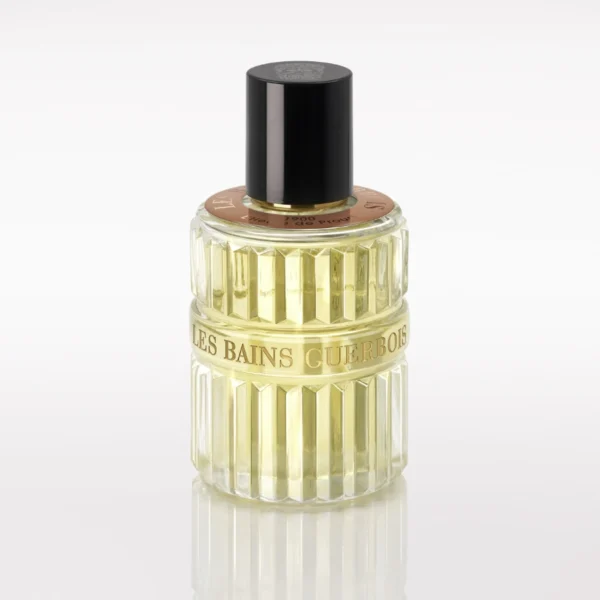
PERFUME AND OLFACTORY MEMORY: WHY DO SMELLS BRING BACK MEMORIES?
Why can a smell suddenly take us back years? Because over a lifetime, it becomes associated with a person, a place, an emotion. When it returns, it can bring back a memory we weren’t even trying to find.
It is one of the most fascinating aspects of olfactory memory.
But perfumery does more than awaken the past. It can play with our memories, reinterpret them and make us dream of times we have never known.
Shalimar, a Mother’s Skin and a First Memory
Ask Jean-Pierre Marois, founder and creative director of Les Bains Guerbois, about his first olfactory memory, and he replies:
“Probably the scent of my mother’s skin mixed with Guerlain’s Shalimar.”
What he remembers is a presence. His mother’s scent and the perfume became inseparable.
For someone else, Shalimar might evoke an era, a bottle on a dressing table or an elegant woman. For Jean-Pierre, it is someone he loved, a childhood memory that belongs to him alone.
The same perfume can be part of very different stories.
A smell need not be rare or extraordinary to become unforgettable. Sometimes it simply accompanied an important moment in our lives. And years later, without warning, it gives that moment back to us.
Why Do Certain Smells Bring Back Memories?
It begins with the odour molecules we breathe in. They stimulate receptors in our nose, which relay information to the olfactory bulb and then to different areas of the brain.
The olfactory system has close connections with regions involved in emotion and memory, notably the amygdala and hippocampus. These connections help explain why some smells evoke personal experiences so powerfully.
The smell of linen in a childhood home, a garden after rain or the perfume of someone who is gone can bring a moment back to mind, along with the emotion attached to it.
A meta-analysis published in October 2026 in Psychonomic Bulletin & Review, drawing on 18 scientific studies, compared autobiographical memories triggered by smells with those prompted by other sensory cues.
On average, memories evoked by smells tended to be experienced with greater emotional intensity and a stronger feeling of being transported back in time. They could also bring back memories from earlier periods of life.
However, the researchers found no significant advantage for smells when it came to the vividness or specificity of memories. The observed effects were selective, generally modest, and varied with the experimental conditions.
A smell can therefore make us feel as though we are reliving a moment intensely, without necessarily giving us more detail. Nor does the strength of the emotion guarantee that our memory is a perfectly accurate account of what happened.
We do not always recover the past as it was, but as it comes back to us.
Proust’s Madeleine: What Does the Passage Really Tell Us?
The expression “Proust’s madeleine” has entered everyday language. Today it describes a sensation that brings a memory rushing back, often one connected with childhood.
Yet in Swann’s Way, published in 1913, the scene is more subtle than the simple smell of a cake.
On a winter’s day, the narrator’s mother offers him tea and has some small madeleines brought in. He raises to his lips a spoonful of tea in which a piece of cake has softened.
A feeling of happiness overwhelms him, as intense as it is inexplicable.
The emotion takes him by surprise before he can understand its source. He tries to recover what caused this sudden joy, searches his memory and attempts to reconnect with the sensation.
At last the memory appears: Sunday mornings in Combray, his aunt Léonie and the madeleine she would offer him after dipping it in her tea or lime-blossom infusion.
This is what Proust explores through involuntary memory. An unexpected sensation awakens something that conscious effort alone had failed to retrieve.
Contrary to the familiar shorthand, it is not simply the smell of a madeleine. The taste, the tea, the cake’s texture and the sensations they produce form an experience intimately bound to the narrator’s personal past.
There is nothing miraculous about the madeleine itself. It becomes extraordinary because it belongs to that past.
Elsewhere, it might be an orange peeled at Christmas, coffee made by a grandparent or the smell of an old book.
The madeleine is famous. But everyone has their own.
1900 L’Heure de Proust: The Art of Disorienting the Madeleine
When we imagined 1900 L’Heure de Proust with Jérôme Epinette, we could have tried to reproduce the smell of a madeleine. It was the obvious choice. Perhaps a little too obvious.
We preferred to lead the senses elsewhere.
Proust is among the figures who frequented Les Bains Guerbois, the bathhouse that opened in 1885 at 7 rue du Bourg l’Abbé. And Les Bains was not only about bathing. There was also the Salon Chinois, where tea was served.
Tea therefore had a natural place in our creation. But not just any tea.
We imagined a bright, tangy opening of pomelo, reminiscent of the La Pie qui Chante sweets of our childhood. Then a black tea with fruity accents, almost like a Mariage Frères red-fruit tea, with blueberry extending the freshness of the pomelo.
And what about the madeleine?
We were not trying to reproduce a pastry faithfully. The gourmand quality was there, but what interested us most was the softness of a cake coming out of the oven. That warm, gentle, almost enveloping sensation, rather than its exact taste.
The praline accord and vanilla help create that impression of softness. There is no madeleine note as such in the official note pyramid. And yet the cake never feels far away.
It remains a discreet suggestion, while pomelo, blueberry and black tea sketch a more unexpected atmosphere.
In Proust, a sensation carries the narrator back into his past. With 1900 L’Heure de Proust, we start from a familiar story and shift the sensations it leads us to expect.
We are not attempting to reproduce a memory that does not belong to us. We are playing with its literary evocation, with the idea each of us has of a madeleine, an hour for tea, a certain kind of tenderness.
Not to reproduce the madeleine, but to unsettle the obvious.
And to leave the person wearing the perfume free to find their own associations, or simply enjoy an atmosphere they imagine.
What If a Perfume Made Us Dream of an Era We Never Knew?
In the late 1970s, Les Bains Douches became one of the Paris stages for a new generation of musicians. Post-punk, new wave, cold wave: bands breaking with convention through their sound, attitude and energy.
On 18 December 1979, Joy Division performed there. One date among those that built the venue’s legend.
But how do you make someone feel an era they never experienced? Someone who might not even have been born?
That is the idea behind 1979 New Wave, created with Dominique Ropion.
We did not set out to reproduce the smell of a concert hall. We wanted to fire the imagination.
Picture a night in December 1979. Or simply the smell of a vinyl record being placed on a Technics MK2 turntable. The first crackle, the bass coming in, the rhythm taking hold. The cold, the electricity of the music and the myth that still surrounds an entire generation of artists.
In the perfume, mint notes bring an almost icy freshness. Iris creates a powdery, earthy tension with slightly metallic inflections. Cedar and sandalwood lend depth to the composition.
No historical reconstruction, no obligation to feel nostalgic. The perfume is a way to imagine that night, feel the energy of the music and dream of an era.
1979 New Wave does not try to persuade us we were there. It makes us wish we had been.
Perfume, Between Memory and Imagination
A smell can bring us back to someone we loved, a place or a moment we thought we had forgotten. But a perfume can also take us somewhere else.
Starting from a story, a piece of music or a sensation, a perfumer can imagine something that never existed in quite that form. They are not necessarily reproducing a smell from the past. They are offering an interpretation of it.
That is a freedom we particularly cherish at Les Bains Guerbois.
Some perfumes remind us where we come from. Others make us want to go where we have never been.
Further Reading
Olfactory memory and neuroscience
Bobei, O. I., Cîrneci, D. and Podina, I. R. (2026). Is the Proust phenomenon fact or fiction? A systematic review and meta-analysis of odor-evoked autobiographical memory. Psychonomic Bulletin & Review, 33, article 264.
https://doi.org/10.3758/s13423-026-03025-z
Olfactory memory and emotion
Herz, R. S. (2004). A naturalistic analysis of autobiographical memories triggered by olfactory, visual and auditory stimuli. Chemical Senses, 29(3), 217–224.
https://doi.org/10.1093/chemse/bjh025
Proust’s madeleine
Marcel Proust, Du côté de chez Swann, first part, “Combray”, 1913.
https://www.gutenberg.org/files/2650/2650-h/2650-h.htm
The musical history of Les Bains Douches
Archives des contre-cultures musicales, Université de Tours, Les Bains Douches programme, 1979–1980.
https://archivesdupunkenfrance.univ-tours.fr/1979/10/30/les-bains-douches/