OUD: HOW A RARE MATERIAL BECAME ONE OF PERFUMERY’S CODES
Published on 16 May 2024. Updated on 1 September 2026.
We thought we didn’t like oud.
Too powerful. Too showy. Too animalic at times. Some interpretations even struck us as downright overbearing.
So we had done exactly what you should avoid in perfumery: confusing a raw material with a handful of perfumes that put it on stage.
Then Mathieu Nardin came along.
At Les Bains Guerbois, we work with perfumers according to a principle we care deeply about: carte blanche.
We tell them a story. An era. A place. A sensation.
Then they are free.
We don’t hand them a list of materials to use because they happen to be fashionable. We don’t ask them to build a perfume to answer a market study. We don’t question the cost of a formula to replace a material they consider essential with a cheaper one.
They have access to the palette they need.
We don’t ask perfumers to prove us right. We ask them to take us somewhere we might never have gone on our own.
So we knew that sooner or later, oud would land on our doorstep.
We simply had to find a way to like it.
Because we have another rule: everything we create, we wear.
IN SHORT
Oud, also known as agarwood, aloeswood or oud wood, is a wood loaded with aromatic resin that forms in certain tree species, mainly of the Aquilaria and Gyrinops genera.
Contrary to an explanation that is often repeated, it is not simply “produced by a fungus”. Its formation results from complex mechanisms linked in particular to wounds, to stress suffered by the tree, to its defence response and to interactions with micro-organisms.
Used for centuries in Asia and the Middle East, it became one of the most visible codes of Western perfumery from the 2000s onwards.
But a perfume labelled “oud” does not necessarily contain natural agarwood oil. The perfumer can also create an oud accord, made of several materials.
And contrary to what one might think, an accord is not necessarily a less noble version of the natural material.
Sometimes, it is precisely what allows the perfumer to interpret it.
WHAT IS OUD?
Oud is no ordinary wood.
In certain trees, mainly Aquilaria and Gyrinops native to South and Southeast Asia, an injury can trigger a defence response. The wood gradually becomes loaded with a dark, aromatic resin.
It is this resinous part that is called agarwood, aloeswood or oud.
The phenomenon has long been summed up by saying that a fungus infects the tree.
The reality is more subtle.
Wounds, insects, stress, micro-organisms and the tree’s defence mechanisms can all play a part in the process. Science is still studying exactly how these interactions work.
What we love about this story is that even before it becomes a perfume, oud is already a transformation.
A tree reacts.
And its wood changes.
WHAT DOES OUD SMELL LIKE?
There is no single smell of oud.
That is probably the first misconception to let go of.
Its profile depends on the species, the geographical origin, the degree of resination, the age of the wood, the conditions in which it formed and the way it is extracted or distilled.
Depending on the oils and their quality, you may find woody, smoky, leathery, balsamic, earthy, medicinal, animalic or sometimes much softer facets.
Some oils can also develop facets that the vocabulary of perfumery describes as faecal.
The word is not very glamorous.
Yet it is more honest than many euphemisms.
And it was precisely one of the facets we did not want to dominate our perfume.
OUD DID NOT WAIT FOR NICHE PERFUMERY
Talking about oud as a recent discovery of perfumery would be historically absurd.
Agarwood has been used for centuries in many cultures across Asia and the Middle East, notably as wood for burning, incense, perfumed oil and in certain medicinal or religious practices.
Its cultural importance therefore long predates its appearance on the shelves of Western perfume shops.
What is recent, on the other hand, is our Western fascination with the word “oud”.
HOW DID OUD END UP EVERYWHERE?
The shift has been spectacular.
According to the database of fragrance expert Michael Edwards (Fragrances of the World), nine Western perfumes containing oud were launched in 2004.
In 2012, he counted 110 in that year alone.
In just a few years, a word that many European consumers barely knew became an instantly recognisable sign of so-called luxury or niche perfumery.
OUD.
Three letters.
An almost instant promise of darkness, precious woods, the Orient, power and rarity.
And that is where things get interesting.
Because when a material becomes a marketing argument, its name sometimes ends up counting for more than what it actually brings to the perfume.
DOES AN OUD PERFUME NECESSARILY CONTAIN NATURAL OUD?
No.
And that is not necessarily misleading.
You have to distinguish between the raw material and the olfactory note.
A natural agarwood oil can go directly into a formula.
But a perfumer can also create an oud accord: several materials, natural and/or synthetic, combined to produce a particular impression of oud.
That is the very principle of perfumery.
A leather accord is not made by distilling a handbag.
A marine note does not require pouring seawater into a bottle.
Perfumery is not about lining up raw materials the way you list the ingredients of a recipe.
It is about composing.
So the question “is there real oud in it?” can be legitimate.
But it is not enough.
A more interesting question would be:
what did the perfumer want to do with it?
NATURAL OR ACCORD: IS “REAL” OUD NECESSARILY BETTER?
No again.
And this idea goes far beyond oud.
We tend to grant natural materials an almost moral superiority: truer, more beautiful, nobler.
Perfumery rarely works so simply.
A natural material can be magnificent.
It can also have a facet that the perfumer does not want at the centre of the composition.
He can then work it with other materials, extend it, brighten it, divert it or soften some of its aspects.
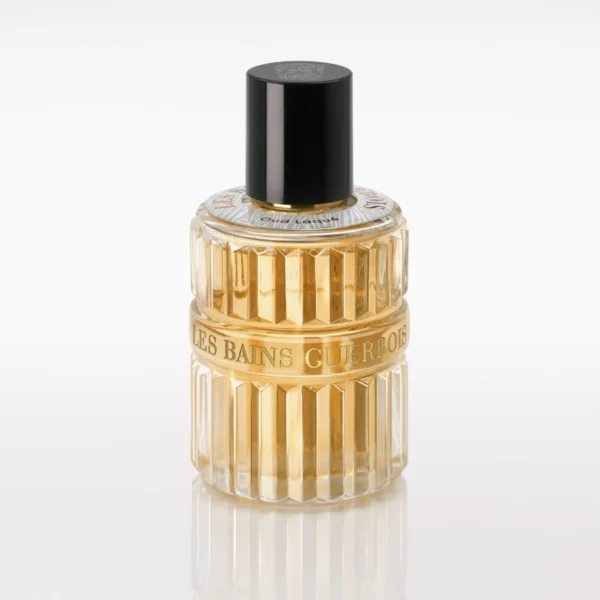
That is exactly what Mathieu Nardin did with Oud Laqué.
He did not choose between “real oud” and “fake oud”.
He used natural agarwood oil, then built a much softer oud accord around it.
Why?
Because we had told him frankly what bothered us.
That animalic, sometimes faecal facet which, in our view, could make some ouds overpowering.
Mathieu did not remove the material to reassure us.
He worked it.
That is far more interesting.
CARTE BLANCHE BECOMES INTERESTING WHEN IT CHALLENGES YOU
Giving a perfumer carte blanche when the result matches exactly what you would have imagined yourself is not very daring after all.
Freedom becomes interesting when it moves you somewhere else.
We had never said to Mathieu Nardin:
“We want an oud perfume.”
We had told him about the lacquered woods of Les Bains.
Their dark surfaces.
Their reflections.
That almost liquid depth of wood when it catches the light.
The oud came from him.
That matters.
The material did not arrive because the collection needed an oud.
It arrived because a perfumer felt it was right for the story we had entrusted to him.
We could have told him we didn’t like oud.
We chose instead to try to understand what he wanted to show us.
OUD LAQUÉ: MAKING AN OUD WE COULD WEAR
So Mathieu Nardin worked from that tension.
Keeping what agarwood could bring in terms of depth, dark wood and sensuality.
But controlling what, for us, caused rejection.
The natural agarwood oil is therefore accompanied by a softer oud accord.
Around it, raspberry creates a fruity, tangy tension. Saffron brings its spicy, slightly animalic facets. Bourbon geranium introduces a rosy vibration. Guaiac wood extends the woody structure. Benzoin and patchouli develop its warmth and depth.
The result does not try to prove that it contains oud.
It tries to build a perfume.
That difference seems essential to us.
Because the rarest, most expensive or most fashionable material does not interest us any more if it does not serve the story.
And conversely, we will never ask a perfumer to give up a material simply because it is expensive, if it is necessary to their work.
Oud Laqué in short: eau de parfum composed by Mathieu Nardin, Formes et Matières collection, 2022. Notes: raspberry, saffron, Bourbon geranium, natural agarwood oil and oud accord, guaiac wood, benzoin, patchouli.
HAS OUD BECOME A MARKETING ARGUMENT?
Of course, sometimes.
Like rose.
Vanilla.
Saffron.
Musk.
Iris.
The problem is probably not niche perfumery itself.
It is what happens when the name of a material starts to replace an idea of perfume.
A list of prestigious materials can be enticing.
It says almost nothing about the quality of the composition.
An expensive ingredient does not guarantee a great perfume.
Neither does a natural ingredient.
Natural oud even less so.
The value of the work begins when the perfumer chooses how to use this material, what to set it against, what place to give it and, sometimes, which part of it to keep hidden.
IS OUD RARE OR ENDANGERED?
Here again, simplistic answers are dangerous.
Strong historical demand for agarwood has put significant pressure on wild populations of several producing species.
The Aquilaria and Gyrinops genera are now listed in Appendix II of CITES, which regulates their international trade. Source: CITES.
But the sector has also changed a great deal.
Plantations have developed in several producing countries, and techniques now make it possible to induce resin formation in cultivated trees.
CITES data even show that since 2017, declared exports from plantations have exceeded those from wild populations.
This obviously does not mean that the issues of overexploitation, traceability or illegal trade have disappeared.
It means that, once again, we have to resist an all too tempting equation:
NATURAL + RARE = NECESSARILY BETTER
The origin of a material matters.
Its traceability matters.
So does what the perfumer does with it.
SO, DO WE LIKE OUD?
That question makes us smile today.
Because it was the wrong question.
Saying “I don’t like oud” is almost like saying “I don’t like wood” or “I don’t like roses”.
There are too many interpretations.
We thought we didn’t like this material.
Mathieu Nardin simply showed us that perhaps we just didn’t like certain ways of treating it.
That is exactly why we keep giving perfumers carte blanche.
Not so they carry out what we already have in mind.
But so they can sometimes change our minds.