NATURAL OR SYNTHETIC IN PERFUMERY: DO YOU REALLY HAVE TO CHOOSE?
Published on 17 May 2024. Updated on 6 October 2026.
Natural feels reassuring.
Synthetic, far less so.
In the popular imagination, a material that comes from a flower, a wood or a resin is bound to be more beautiful, nobler, healthier and kinder to the environment than a molecule made by synthesis.
Natural or synthetic in perfumery: the reality is far more interesting than this opposition suggests.
A natural material can be extraordinary. It can also come from an overexploited resource, vary from one harvest to the next, or naturally contain substances whose use has to be carefully controlled.
A synthetic material can be ordinary. It can also be extremely pure, give the perfumer remarkable precision and make it possible to create sensations that simply do not exist in nature.
At Les Bains Guerbois, we have a deep love of natural materials.
But we love what a perfumer can do with them even more.
DOES NATURAL MEAN SAFER?
No.
It is probably one of the most persistent misconceptions about perfume.
An essential oil, an absolute or a natural extract is generally not made of a single molecule. It is a sometimes very complex blend of compounds, some of which can be allergenic, irritating or prone to oxidation.
IFRA points out that the safety of a substance depends on its properties, the dose and the exposure, not simply on whether it is natural or synthetic.
This obviously does not mean that natural is dangerous.
It means that natural is not the same as harmless.
Quality and the work done on the material matter too.
A natural material can be distilled, purified, rectified or fractionated to better control some of its constituents. Its stability, purity and consistency can also be checked.
Conversely, a precisely characterised synthetic molecule lets the perfumer know exactly what they are working with.
So a well-controlled synthetic material can, in some cases, be more predictable than a poorly controlled natural extract.
The real reasoning is not:
natural = healthy
synthetic = dangerous
It is:
which material, of what quality, at what dose and in which formula?
IS SYNTHESIS AN IMITATION OF NATURE?
Sometimes.
But reducing synthesis to a cheap copy of nature would erase a large part of the history of modern perfumery.
From the late 19th century onwards, chemistry greatly expanded the perfumer’s palette.
It made it possible to reproduce certain molecules found in nature, but also to give perfumers new materials and new olfactory effects.
A molecule can amplify a flower.
Give air to a wood.
Create diffusion.
Bring in a metallic, clean, abstract or luminous texture that a natural material alone could not achieve in the same way.
Synthesis can make nature more beautiful.
And sometimes it does not even try to imitate it.
It invents.
1979 NEW WAVE: WHEN SYNTHESIS EXPANDS THE PERFUMER’S VOCABULARY
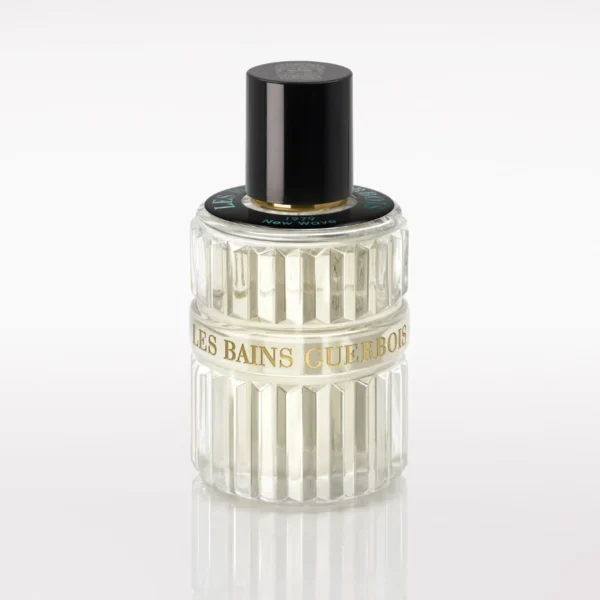
In 1979 New Wave, Dominique Ropion pairs two mints with aldehydes in the top notes, ahead of an orris concrete with earthy, metallic inflections.
The word “aldehydes” refers to a family of molecules, not to a single ingredient.
Some aldehydes occur in nature. Many others are used in perfumery in forms obtained by synthesis.
In New Wave, we have no interest in setting natural orris against the perfumer’s molecular tools.
It is precisely the dialogue between them that interests us.
The aldehydes contribute to the cold, vibrant, abstract sensation that then meets the more earthy materiality of the orris.
Without that vocabulary, Dominique Ropion would probably have told a different story.
So synthesis is not necessarily there to replace nature.
It can be there to set it in motion.
IS A NATURAL MATERIAL NECESSARILY MORE SUSTAINABLE?
Again, no.
A flower, a tree or a resin does not become environmentally virtuous simply because it grows in nature.
A natural material needs land, time, water, labour and sometimes several years of growth before it can be harvested.
And when a material becomes rare, expensive or highly sought after, the pressure on the resource can become considerable.
INDIAN SANDALWOOD: WHEN A MATERIAL FALLS VICTIM TO ITS OWN SUCCESS
Indian sandalwood, Santalum album, is a perfect example.
Its wood and its oil are among the historic materials of perfumery.
But its exceptional value has also fuelled overexploitation, illegal felling and smuggling.
For decades, demand for this precious material put considerable pressure on wild populations in India.
This does not mean that using natural sandalwood today is necessarily irresponsible.
Plantations exist. Cultivation policies have changed. Better-controlled supply chains have developed.
So the problem is not:
“Can we still use natural sandalwood?”
Of course we can, when its origin and its supply chain are sound.
The real lesson lies elsewhere.
A beautiful natural material is not enough. You also need to know where it comes from.
GUAIAC WOOD, OR PALO SANTO: WHEN THE NAME BECOMES AS DESIRABLE AS THE SCENT
Guaiac wood takes us even further.
The species long known as Bulnesia sarmientoi, now botanically accepted as Plectrocarpa sarmientoi, grows naturally in South America, particularly in the Gran Chaco region.
Its wood can be distilled to obtain an essential oil used in perfumery.
And guaiac wood also goes by a name that is now much more familiar:
palo santo.
Or “holy wood”.
The term has become particularly desirable in recent years, well beyond perfumery.
You find it in perfume, incense, wellness and home decor.
But we need to be precise.
Palo santo is not a botanical identity.
The same name can cover several species, several materials and sometimes simply an olfactory evocation.
Plectrocarpa sarmientoi, or Bulnesia sarmientoi in the nomenclature still widely used by the industry and by CITES, should in particular not be confused with Bursera graveolens, another species commonly sold as palo santo.
When a material becomes fashionable, these distinctions stop being trivial.
Which species?
Which origin?
Which extraction?
Which supply chain?
Bulnesia sarmientoi is listed in CITES Appendix II and its international trade is regulated.
The rules mainly concern the material further upstream, such as the wood and certain extracts. Finished products containing these extracts, including fragrances, are treated specifically in the applicable annotation.
So the point is not to suggest that a bottle containing guaiac wood is in itself a problematic product.
The point is the supply chain that comes before the bottle.
And that is precisely where our responsibility as a brand begins.
AT LES BAINS GUERBOIS, WE PREFER NATURAL WHEN WE CAN CHOOSE IT PROPERLY
We love natural materials.
Their richness.
Their accidents.
Their variations.
A richness that a simple technical data sheet cannot always convey.
When the perfumer genuinely has a choice between a natural material and its synthetic alternative, and when both the quality and the supply chain suit us, our preference goes to the natural.
But that preference comes with a responsibility.
We pay attention to the materials we use and ask our suppliers for the necessary guarantees on quality, compliance, origin and traceability whenever a resource calls for it.
We do not want to use a natural material simply because its name looks beautiful on a fragrance pyramid.
We want to understand what lies behind it.
But this preference for natural does not mean that we see synthesis as an inferior version.
That would be missing the point of perfumery itself.
AND YET, WE ALSO DEEPLY LOVE SYNTHESIS
Because a perfume is not an inventory of beautiful raw materials.
You can pile up the rarest flowers, the most expensive woods and the most sophisticated extractions without ending up with a great perfume.
The value of a formula is not measured by the number of natural materials it contains.
The material is only the beginning.
Then comes the perfumer.
And one of their finest tools is the accord.
THE ACCORD: WHEN SEVERAL MATERIALS BRING OUT A NEW SCENT
An accord is born when several ingredients are combined in such a way that our nose ends up perceiving something other than each of them on its own.
It is probably one of the most beautiful kinds of magic in perfumery.
The perfumer does not necessarily look in nature for the ingredient that will smell exactly like what they imagine.
They can build it.
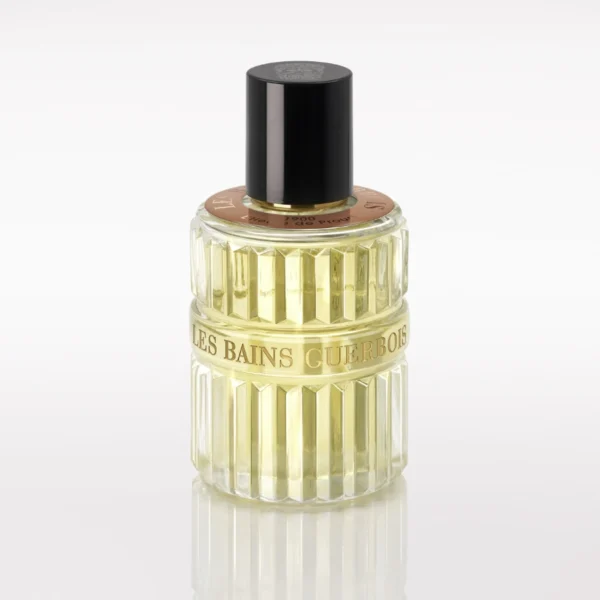
In 1900 L’Heure de Proust, Jérôme Epinette worked on a black tea accord.
In our creative work, this accord draws in particular on bergamot, maté and guaiac wood.
Taken separately:
bergamot is not black tea;
maté is not black tea;
guaiac wood is not black tea.
But when they are worked together, a new impression appears.
Black tea.
That is why the opposition between natural and synthetic ends up being inadequate for any serious discussion of perfume.
The perfumer of course works with materials.
But above all, they work with the relationships between them.
A FRAGRANCE PYRAMID IS NOT A FORMULA
This distinction also helps explain something that the vocabulary of perfume sometimes makes confusing.
When a pyramid lists:
black tea,
leather,
smoky note,
saline note,
palo santo,
or even certain fruits and certain flowers,
it does not necessarily mean that a natural extract bearing exactly that name is in the concentrate.
It may be a natural material.
A synthetic molecule.
Several natural materials combined.
Several molecules.
Or an accord blending the two.
Above all, the pyramid describes what the perfumer wants you to smell.
It is not a transcription of the formula.
And thankfully so.
Because if perfume simply meant placing the materials on a list side by side, the perfumer’s craft would be far less fascinating.
ARE NATURAL AND SYNTHETIC STILL TWO OPPOSING CAMPS?
Perhaps this is where the real misunderstanding lies.
We often talk about natural and synthetic as if they belonged to two irreconcilable philosophies.
Nature versus chemistry.
Authenticity versus artifice.
Tradition versus modernity.
But a contemporary perfume is often all of these at once.
A natural material can give a composition its soul.
A molecule can bring it light.
An accord can give rise to a scent that existed in none of its components.
A particularly precise extraction can make it possible to work a natural material differently.
A new molecule can give the perfumer a possibility they did not have before.
Perfumery has never stopped moving forward precisely because it has never really chosen between nature and invention.
SO, NATURAL OR SYNTHETIC IN PERFUMERY?
At Les Bains Guerbois, we have a clear preference.
When we can choose a beautiful natural material from a supply chain we consider serious and sufficiently traceable, we choose it.
But we refuse to turn it into a moral superiority.
A poorly controlled natural material is not automatically preferable to a perfectly controlled synthetic one.
A formula rich in natural materials is not necessarily more beautiful.
A formula that makes wide use of synthesis is not necessarily less noble.
Synthesis is not the enemy of nature.
It can accompany it, illuminate it, extend it, contrast with it.
Make it more beautiful.
In the end, the most interesting question may not be:
“Is it natural or synthetic?”
But:
“Why did the perfumer choose this material, and what did they do with it?”
Because between nature and chemistry lies what matters most.
The perfumer.